
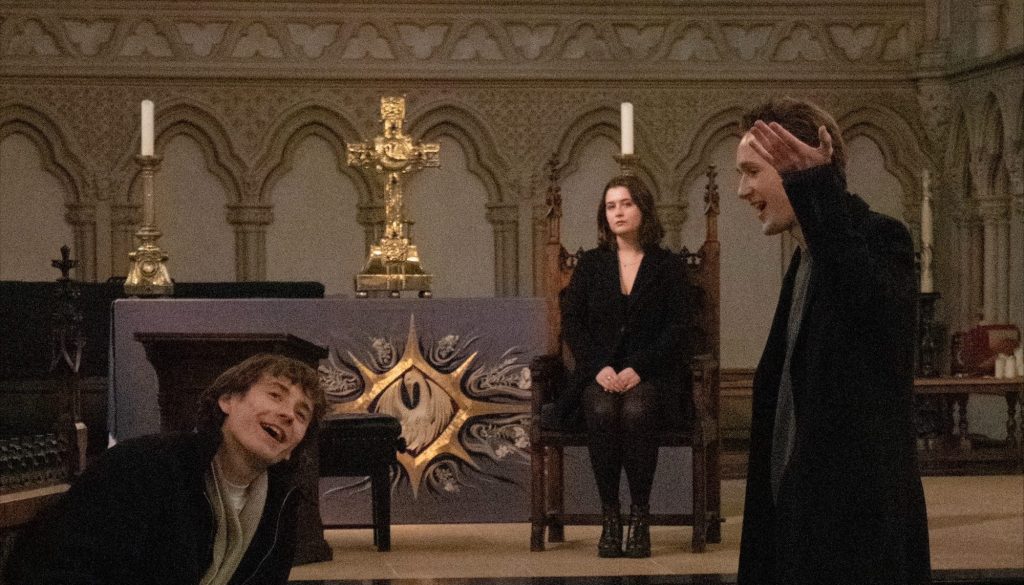
The Duchess of Malfi showed at the Corpus Christi Chapel from the 31st January to 3rd February 2024, donating all profits to Bloody Good Period.
Rida Fatima
“Like diamonds we are cut with our own dust”: these last words uttered by Duke Ferdinand echo in Corpus Chapel, almost bringing an end to this hauntingly, powerful performance of bloodied love and bruised revenge between siblings. This play was certainly a bloodbath of entertaining agitation.
The Duchess of Malfi is a Jacobean tale of two brothers’ obsession with rank and honour, and yet they scheme through dishonourable means in order to destroy their sister’s lowly marriage and uplift their own interests. As if women don’t already have to deal with melodramatic and overly entitled men enough, the Duchess has to deal with three who constantly scheme and spy on her the entire play, obsessed with her sex life.
The main themes in the play are corruption and sexism which permeate through the Cardinal and the Duke, both men who lose themselves in greed and rage as they use their status to utilise the rest of the court as their pawns. Joshua Herberg as the Duke was nothing short of phenomenal in his delivery. The relentless pain he felt because of his sister’s promiscuity, exacerbated by his own repressed incestuous desires for her, were exemplified through his racing monologues. They shook the entire chapel as the fury in his voice and tantrums reverberated against the audience and stage. It was captivating to watch. The wilderness in his eyes and crazy obsessive love for his sister shaking his core were perfect at illustrating the overwhelming control and entitlement men feel over women’s lives, especially in the context of the fetisizing power he held over the Duchess. Joshua stole the show with his lunacy.
The Cardinal, on the other hand was much calmer and sinister in nature, and his affair with Julia, a married woman, is one of the first things we see as the play starts, setting the themes of malfeasance and corruption. Leo Kang Beevers as the Cardinal was chillingly cool, and his arrogant tone masterfully demonstrated his own egotistical nature. One of my favourite scenes in the play was when the Cardinal takes away the Duchess’ ring and banishes her to exile, the music ringing in his ears as he slowly descends down the aisle of the chapel in the dim light, chanting to himself whilst stripping away his red cassock as if he is visibly being undone by his anger. It was like an uncloaking of majestic argonian honour – a descension of the holy body.
The Duchess herself was rattingly and elegantly portrayed by Emily Gibson, who did a great job of presenting her as steadfast and sure of her own decisions – irrespective of the risks and dangers that lay ahead once she had picked Antonio as her husband. The funniest scene was when she was given ”labour-inducing” apricots by Bosola, and her reaction to them being possibly coated in ‘dung’ was hilarious. However, it was the dramatic moments – her horror at discovering her ‘hanging husband’, her never ending confrontations with the Duke, and the harrowing scene of her murder enveloped by the fear in her eyes as she gets choked to death – that were masterfully done.
The character of Bosola was very well done by Joe Wright, who put in a lot of energy and nuance to show us his ever-changing conscience – choosing between being a loyal subject or a decent person. His eventual murder of both brothers was a very critical scene, crafted with gusto and exhausting anguish. Whilst the main character did do a great job, I think the real magic lied with the supporting cast – they gave us a range of performances and helped drive the plot with a variety of emotions, since sometimes the constant rage and melancholy from the main character could get tedious and overstimulating.
The setting – the Corpus Chapel – was the glory of this play. What an amazing idea! Not only did it capture the gothic overtones of Webster’s plot, but it created a live court in front of the audience. The ornate walls and shivering candles created an immersive experience. That being said, because of the audience’s placement, it was sometimes hard to actually hear what the characters were saying, especially in the beginning when some actors mumbled or hastily sped through their dialogue. This meant that sometimes an important scene would occur, but the context was indiscernible; I felt like if I hadn’t already read the play, I would be guessing the plot and trying to piece it together like a puzzle.

The acting was overly exclamatory at moments, and there were many times when faces in the audience were awkwardly looking on at the incessant screaming by an actor, without feeling any attachment towards the scene. But most of the time, the emphatic and intense acting by these actors was beautiful and pulled apart our mouths, stretched our eyes until they were agape with stress, and left our minds uneasy with fear of also being strangled by the hands of corruption and misogynistic rage.
However, there were times where the actors brought too much energy at a constant rate, which oversaturated the meaningfulness of their outbursts and could’ve tired the audience. I would have loved to see a slower-paced build-up during their speeches, so that it’s more gripping when they do perform an aggravated or agonising scene, rather than what felt at times like strained, consistent yelling.
When reading the play that this performance was based on, the time intervals are more clear-cut, and you can tell when there has been a long gap between the characters’ interactions. However, as I watched, each scene seems to jump into the next with little regard for time and setting. You can’t tell that the Duchess’ marriage is meant to be successfully hidden when instantaneously the court walks in, whilst the two have been canoodling in the open. You can’t discern that the Duke discovers his sister’s marriage two years after it occurs. Perhaps the speech performed by the characters was meant to fill this void, but I don’t think that you could properly hear what they were saying due to the nature of the staging – I think that reading the play beforehand makes for a clearer and richer experience of the performance.
Ferdinand’s line, “She and I were twins; And should I die this instant, I had liv’d Her time to a minute,” effectively sums up the play. Despite being genetically near-identical, this play shows how just one different factor, sex, is the ultimate trump card from which a power dynamic blossoms. The Duchess’ only transgression was being a woman, and her murder by her own brother for honour is a truth that is lived by many women around the world today, not just constrained to the Gothic wisps of the past. Watch this play in order to see the mirrors of women’s modern suppression as well as the permeation of political amorality and unscrupulousness. I hope that John Webster’s play will be brought to life again in Cambridge in the future.
Image Credits: Publicity photograph of the Duchess of Malfi cast

 Cambridge Girl Talk