
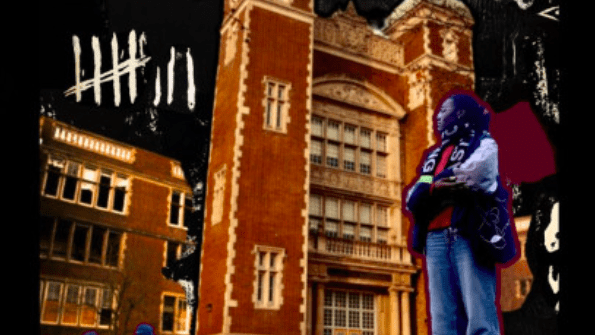
Blackboard (Keep ya’ head up) showed at the Corpus Playroom from the 21st February to 24th February 2024
Rida Fatima
Blackboard was written by Tia-Renee Mullings and Katiann Barros Rocha, and presented by Bread Theatre & Film Company.
Somewhat hauntingly biographical in its accuracy, and golden in its comedy, Blackboard is a play that perfectly captures the isolation that comes with being a woman of colour, specifically a black woman, in Cambridge. The main character Adina, played by Christabel Okongwu, is bombarded with the otherness, self-antagonisation and guilt which follows her like gum under a shoe as she walks around her prestigious university which she once naively dreamed of as her biggest achievement.
As she takes on this big change, we are introduced to the characters in her life: her supportive but critical friends, her undermining and self-important white classmates and professors, as well as her white boyfriend who plays a pivotal role in breaking the rose-tinted view she had of her university experience. The symbolism and writing was so well done that it felt incredibly personal, and Adina’s misfortunes were met with a melancholic pang in my laugh; it felt very bittersweet for me to relate to them, as a brown, Muslim woman myself.
The writer’s symbolism of the “black card” and the “blackboard” was an amazing way of incorporating how racial pressures ironically can feel even more pertinent coming from your own race rather than others. Even though racism is always perceived as an outward source, some of the most intimate criticisms I’ve ever experienced towards my identity have been from fellow South Asians who don’t think I’m committing to my culture by trying to move out to Cambridge. Similarly, the play begins with Adina being criticised by some of her friends for compromising her black identity by trying to homogenise in an environment which once benefited from the exploitation of her ancestors. The tension between assimilating with such an institution was fantastically portrayed by the actress whose stress and journey of self esteem was smoothly conveyed throughout the play. Hafsat Isaac-Momoh, Alex Clovis and Aker Okoye were brilliant at playing Adina’s friends as well as the judges of the black council (assessing whether to revoke Adina’s black card), and were very reminiscent of Aeschylus’s furies, who scrupulously assessed her every move and whether it was uplifting the black community. They were essential in bringing in the comedic undertones of the performance and their witty lines spit across the stage.
The pressure and isolation from the cultish, white majority in the prestigious university was also something much more darker and condescending. From the “Rule Britannia” blindly patriotic, sing-songy lecture attendees, played excellently by Martha Gazzard, Alfie Cason and Maxim Knowles, to the heart-stopping moment of hearing her boyfriend, played by Harry Mitchell, say a degrading slur in a pop song, Adiana faces all sorts of challenges and undermining remarks from the white people around her. Many women of colour in Cambridge can relate how sometimes being picked by a white guy guiltily serves as a form of validation, how sometimes they get doubted as a student because of their skin colour, how their friends from privileged backgrounds overlook the magnitude of this isolation because they can never experience it. The white noise is deafening and the actors playing such insufferable and self-absorbed characters did an amazing job at being caricatures that the audience can both laugh at as well as pricks they can hate.
The white-saviour complex which came through the defensive boyfriend and the pamphlet-faced feminism Sidge girlie was a very complex theme that the play dealt with. Indeed, sometimes the people who think they are doing good for us, ‘standing up for the minorities’, are in fact reducing people of colour to victims and positioning themselves as the knights in shining armour of the struggle. The Sidge Girlie actress, Elise Batchelor, was acutely accurate at displaying the self-important ignorance that many white feminists display when they overshadow the postmodern feminist thread – her whiney voice and hilarious attention seeking mannerisms and commentary were a highlight of the show.
Some criticisms of the performance is that the overacting at times made some scenes in the beginning a little difficult to watch. Okongwu as Adina did an amazing job and was able to cover a lot of complex emotions – the cognitive dissonance of being a Cambridge student whilst also simply dealing with the embrace of adulthood was portrayed so well. However, there were instances of over-acting in her delivery, as well as some of the other actors, and the monotonous exasperated tone sometimes made it hard to take seriously. Some of the scenarios written in the script were also very on the nose and so stereotypical that they felt a bit forced – like the writers were trying to tackle every issue at once and just threw in every experience for the sake of plot. However, because the script was so golden and the themes were developed carefully, the play got away with doing this. Never have I been to a play before where the audience could not stop laughing and for all the right reasons.

 Cambridge Girl Talk