
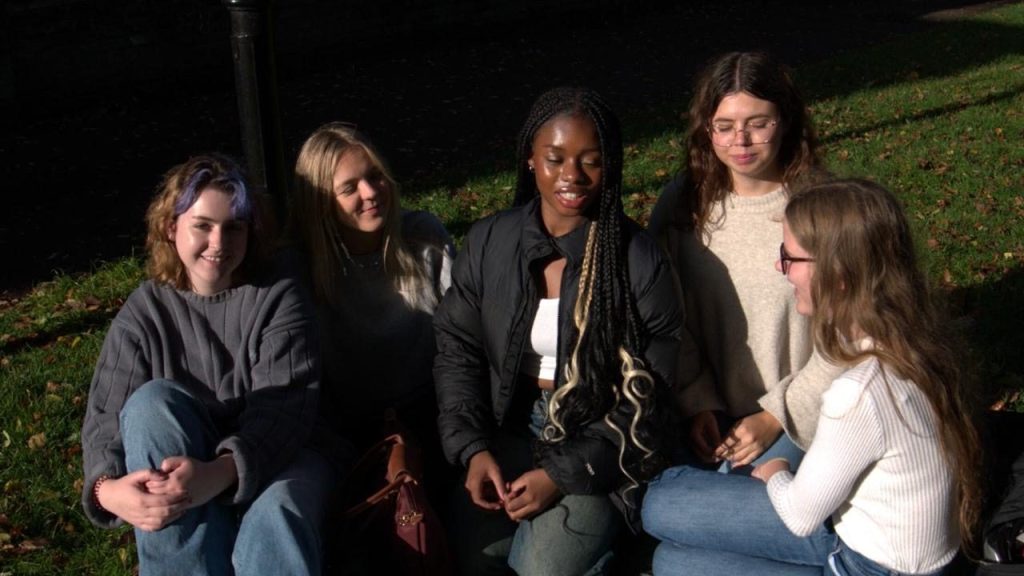
Our Town Needs a Nando’s showed at Corpus Playroom from 29th October – 2nd November 2024
Rida Fatima
The first word that came to my mind after watching this performance was ‘chemistry’ – the cast’s chemistry was groundbreaking. Scenes together were so strong and impactful that not a single member looked out of place. Whether creating ridiculously dramatic and satirical GCSE performances or talking about the shitty aspects of their long lost town, it felt like we were peering into the four walls of this eccentric friendship group.
Themes
In my interview with the director Ruby, she explained how this play is about a town so small that there is nothing quintessentially British or alive about it. We have this dichotomous environment that contrasts fresh, lively youth with a boring and aged monotonous town. This was well portrayed from the start of the performance. My favourite subtlety was the attention to symbolic detail that Rachel had set up. For example, there was a strong motif of the colour purple in the play from the scrunchies, posters, clips and hair ties in the costumes. The ode to purple – the internationally recognised colour for women and gender equality – cemented the main themes and aims of this play. This was a play about the failure of system for women, made evident from scenes such as “an assembly for the girls”, which depicted the blame placed on women in sexual assault, told to be more careful rather than men being told not to rape. This is further portrayed by the systemic misogynistic books young girls have to read that prompts the question “where are all the girls?” when we look at literature and historical focuses in the educational system.
Casting
The casting was strong and uniquely put together – Ruby explained that she purposefully went for inexperienced and fresh faces to extend the floor to students outside the Cambridge University bubble. All were spectacular but the two actors that stood out for me were those of Zaheeda and Beth as they were natural and effortless in how they portrayed their roles. Beth’s monologue about her dad losing his job tackled the issue of poverty in small towns through the rising issues of redundancy and the effect of slow, local commerciality. The fact that Beth wanted to go to university but realised that realistically she should take up a job full time and quit school to support the family (“paying the rent is what counts”) is so haunting to watch as Cambridge students in a city so far from her situation. She embodied the small town dilemma: that there’s structural pain, there’s cyclical torture.
Zaheeda is so funny and adds something special to the play. Her brownie scene is hilarious and has the audience ecstatic with amusement. She used to be the new girl in town who initially arrived as a refugee and is a contrasting foil to all of the other characters who grew up there. The director pointed out how she was worried Zaheeda’s character could be the most stereotypical and one-dimensional in the script, so it’s amazing to see how well they’ve done with her character as this actress was phenomenal.
The other characters artfully capture other themes, such as child neglect through Ellie, queer discovery through Rachael and psychological trauma through Chloe. Comedic timing and emotional depth held up performances throughout.
Some Shortcomings
My biggest criticism is that the ending fails to achieve anything, even if it was purposefully unresolved as a symbol of the inadequate state of women’s rights. It feels like too much goes on, obstructing understanding, though this is more a criticism of the script than the director or cast.
The flashes of rape scenes coupled with the catastrophe of young homosexual relationhips in the sphere of heteronormativity, and worsened by the economic depravation holding young people back from prospective achievement – was a little too much. Some may argue that this is the point; a multitude of issues like these do exist in reality in these kinds of towns. However, my problem was that this was not properly addressed. None of it is really tied up with the hole of Chloe being raped by a man at the end of her ‘false’ excursion incurred by her two other friends. The end could have been left out, and its omission would be minimal.
In the interview, I was told how the main focus on this play was the small town experience which is something that would open new discourses and opportunities to relate for some in the Cambridge audience. However, in reality this point felt like a hungry dog that was underfed as it was lost under competing themes. This play is better suited focusing on how women are disproportionately subject to sexual violence, and how this has slipped into the universal female experience. The additional themes seem to just bombard the audience.
The director said that this production of Our Town was the second ever, and the first performance was similarly criticised for how the play was swallowed by the Herculean task of the writer trying to tackle everything: generational poverty, crime, diversity, the female experience and psychological youth issues. She was clear that she aimed to make these issues flow in a more smooth fashion. While I noticed how much more cohesive their production was, the plot was the root problem of this confusion as it failed to intertwine different factors together.
Regardless, the production worked fantastically with the material they had and I was thoroughly entertained by the acting and creative staging.

 Cambridge Girl Talk