
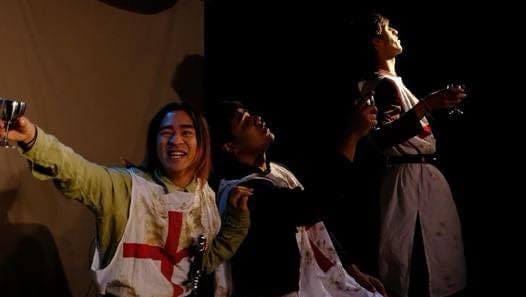
In Conversation with Amie Brian.
Girl Talk’s Phoebe Morse sat down with writer and director of ‘Negotiating with the Dead’, Amie Brian. ‘Negotiating with the Dead’ covers the discovery of a medieval relic and the archaeologists and past crusaders who connected through it. It questions faith, violence, history, and morality.
The production is in partnership with charity War Child and is being performed from the 13th to the 16th of November in Corpus Playroom. You can buy tickets and donate here.
All views expressed are those of the interviewee.
CN: sexual assault, violence, racism, swearing
Could you summarise what the play is about, in your eyes:
A team of archaeologists find a fictional relic from the Crusades. The lead starts to hallucinate a group of Crusaders who were looking for the relic, and it questions how we treat historical relics, asking: have the ways we regard icons changed? With people wanting to buy and display them, have we replaced religious value with capital?
So, what was the inspiration behind Negotiating?
The play was written for the Pembroke Player’s Playwrighting Competition in 2023, based on the theme, ‘Panacea’, or a ‘cure for all ills’. It got me thinking about relics and how it feels for believers if the miracle they believed in doesn’t materialise. From there, I delved into my relationship with religion; faith can be a positive societal force beyond the political landscape. Negotiating was born out of my frustrations seeing authorities using it to further personal agendas. The play intends to draw out what faith is and what we have let faith become. The crusaders discuss their purpose, trying to justify a war under religious precedent. This holds a mirror against our time to ask if we have learnt from our past.
Other than your religious journey, what else inspired you?
In some ways, the play is an emotional response to my first visit to the Vatican. I expected the visit to be a personal, spiritual moment, but what struck me is that it was very much a museum, tied up in its political and colonial histories. This play partly satirises the institutionalisation of faith. We aren’t arguing against faith, but rather considering how it can manifest positively. That’s where the archaeologist, Imran comes in: his Muslim faith manifests in his loyalty, forgiveness and self-belief. That’s a beautiful manifestation of faith, and it’s different to the religion the Crusaders claim to follow.
Let’s get back to that faith, given the intensely personal nature of the play – how do you identify and consider your religiosity?
I identify as Irish Catholic, and, given its turbulent past, I wanted to reflect on how my religion has revolved around politicisation and violence, to understand where this violence comes from. Men like the character of Lord Behemond warp scripture for political ends, nothing to do with God and faith. If people believe this manipulation, it hands epistemological power to those creating violence. But it also argues that faith can be a source of positive change, rather than bound to its violent past. This could have been set in any historical period, but I thought relics mirrored past and present.
You chose the Crusades though, specifically, to grapple with the themes. What drove this choice, and how much do you feel you must stick to historical accuracy and deal with controversial histories?
I write historical fiction, and when writing I try to do what I can to ground in realism but beyond this, fiction is where you can play and probe into deeper questions… without causing offence and issues with copyright!
I chose the Crusades because they’ve become a symbol of British nationalism in an explicitly racist way. In marketing, people suggested marketing the play to history students or older audiences expecting a Shakespeare-esque history, but I wanted to go in the opposite direction. That’s the benefit of intense theological debates; it has to be a dialogue, and as a choral drama there are multiple voices. It allows characters to be horrible and realise their flaws – you can’t do this in other spaces. In university settings, the cowardice and vulnerability of historical figures are often brushed over. In glorifying history, we can forget the role of human stupidity and fear.
You want your characters to be allowed to be ‘horrible’, cowardly, and vulnerable; do you feel that female characters are often written without much complexity?
There’s been a trend recently to need strong female characters, but with this, they are expected to be good and moral – I see these as redundant words which exclude complexity, and as an actress and director this frustrated me. Women couldn’t be spiteful and still fit the bounds of ‘goodness, and they sometimes become trapped by the Madonna/whore complex.
Florine, my protagonist, has recently lost her family and is having an apocalyptic experience of faith. While talking to Imran, she says religion is all lies, but she’s lashing out. Yes, she’s being ‘horrible’, but she’s also grieving, bitter, and wants to be heard. It’s important to stage this: faith is not perfect nor is it blind, and people experience it because they question it.
Audiences don’t always react well to these kinds of women. I’ve had people tell me Florine is a ‘bitch’ whilst being easier on the Crusaders going through a similar questioning and lashing out. Men are allowed to lash out and it is noble, masculine and part of being a hero – if women cry, scream, and say horrible things they are dismissed as hysterical. The double standard is frustrating.
Speaking of women being held to certain standards, do you feel pressured to approach your writing from a feminist angle?
I don’t feel I can separate from it but it’s not an external pressure. I don’t think I will ever write a play that is not a feminist. When I’m acting, I think about the women I play and where their strength comes from. I found myself getting bored of the characters, getting the same type again and again.
Originally, I was satirising masculinity in its violent form, prevalent in British culture even now. To me, the play was always feminist but on its original run I realised it was a feminist play about men. I needed to think about where the women were. When writing historical fiction, it’s often hard to find women when sources are missing.
When you’re a female writer, there are marketing pressures to emphasise your Girl-bossery. I’ve taken the direction where I believe theatre needs to go because men have already been allowed there.
As you mentioned, this is a re-staging of the original run from the Pembroke Players, have you made any changes?
I wasn’t as involved as I am now – as director, I’m involved in all creative aspects. I tried to limit how controlling I am! It’s not always good to have the writer involved, but I have an amazing team around me: they’ve taken the script and made it what they wanted. It’s fun to be involved this way, seeing what works on the page versus what works in practice.
We upped the female presence with another archaeologist, Aliya. I added another scene between the young crusader and the encampment whore, who becomes a spiritual adviser to him. She comes from a position of strength but doesn’t yield or allow him forgiveness. We needed to nod to the sexual violence of the time without victimising women – I didn’t want to have an explicit scene of male domination.
Do you have a favourite scene?
The one between Lilith and Isiah; it’s new and I was experimenting. I’m working more with stichomythic dialogue, 3–4-word lines. With this technique, silence and pacing are key. This can be more impactful when approaching themes such as sexual violence. Plus, the actors are so good in that scene!
Why should an audience come and see the show?
It balances spectacle with probing questions – if the audience is open to exploring challenging opinions of their faith then they will enjoy it. It’s cleverly lit, with moments of sword fighting and emotional explosions balanced by moments of reflection. Come for the spectacle, stay for the theology!
Anything you want the audience to take away from this show?
There’s hope; faith and community come from a hopeful place. It might be vulnerable and wounded but it is truthful. There is an actionable process we can follow to think about how faith interacts with history, museums and our lives. Different perspectives can coexist, and our histories might not own us, but we need to ensure we remember them and own them.
What would you like to say about your partnership with War Child?
I wanted to do this fundraising last time – staging the play again wasn’t only for my literary and directing development, but allowed me to consider what you can do. Recently, I’ve felt political hopelessness in the face of global events, where you want to help but there’s little you can do. I decided that if I put the show on again, I would raise some money for children in Afghanistan, Gaza and Ukraine. Children are so often victims of political and religious wars. I wanted to re-insert Negotiating back in reality and link the audience to action: Do we keep talking in circles? Or can we make a real impact on the world?

 Cambridge Girl Talk