
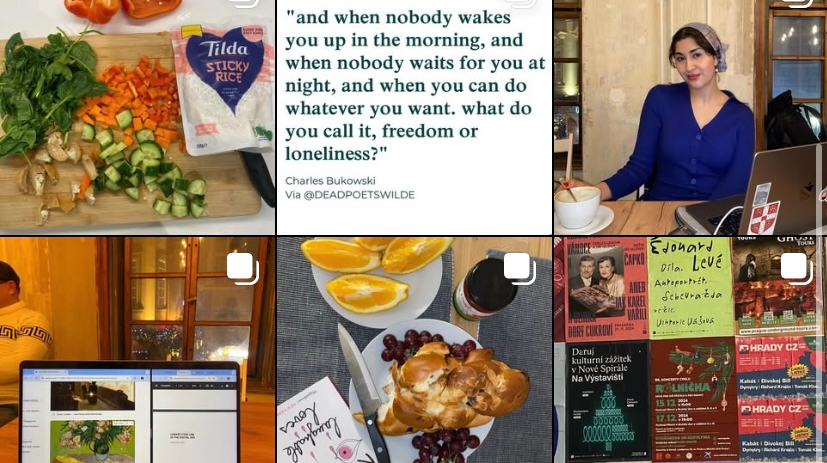
Rida Fatima
As I highlight the sentence in the book that my dad gave me, The Denial of Death, the words smothered in green ink read “the whole thing boils down to this paradox: if you are going to be a hero then you must give a gift”.
My cat eye sunglasses have been tactically placed onto the pages of this book, with the inside of the book’s spine decorated with meticulously styled earrings. The weight of a deliciously new honey oud perfume rests on one of the pages like a paper weight, showing off the chic Arabic lettering.
I took this picture of my ‘random things’ in the dark of my room at 6:37 pm. All collected to create some sort of aesthetic collage – but the question is why? What is the need for the man-made fusion of imagery, captured in faux nonchalant angles and flashes in the dark? What do I get out of forging this collection of items like a blacksmith, to post as a display of myself? What does it say about me?
This is the art of “the presentation of self in everyday life” , a titular phrase coined by Erving Goffman.
The Perversity of Self Expression
In this book, Goffman uses the metaphor of theatrical performance to encompass how a person in everyday social intercourse presents himself and his activity to others. Man attempts to guide and control the impressions that others form of him, and the ones he forms of himself. In the digital era, this takes new form through our posts and feeds on social media. Why do we all engage with others’ self expression so desperately? Goffman notes that information about an individual helps to define the situation they are in, enabling others to know in advance what he will expect of them and what they expect of him. Spectators can take inspiration or mimic the behaviour of others to fit into social norms or discover how to be a ‘better’ version of themselves.
This echoes Miranda July when she says, “ All I’ve ever really wanted to know is how other people are making it through life – where do they put their body, hour by hour, and how do they cope inside of it.” Social media seems to be a secret portal which allows us to find the answer to these lingering questions. However our curiosity paired with our desperation to showcase a part of ourselves , creates a perverse cycle of sycophantic behaviour. An individual’s curated Instagram feed is a stage where they spotlight the life they want others to believe they have.. The profile carefully omits anything that doesn’t fit their desired image, creating a vicious cycle of validation that others may find entertaining or a basis for comparison.
Critical Feminist Theory
Many feminist theorists have credited social media for giving women creative power to negotiate their identities, represent themselves, and resist male-directed narratives (Forbes). It helps to show women as more than gendered objects, but rather talented, capable, and intelligent beings (Forbes…Krane). However, it also reinforces power dynamics between men and women . In ‘The objectification, sexualization and misrepresentation (social media and the college experience)’ by Stefanie E Davis, he notes how social media use greatly impacts self-identification and self construction of gender. It seems that women actually feel more pressure to change the way they present themselves on social media based on how they see other women do so (who may be indirectly affirming subjugation to the male gaze).
Women may feel that they need to learn how to be more like a ‘proper’ woman by adopting any traits that are desirable, “cool”, and effortlessly chic, as seen on Instagram posts and stories. A trend at the forefront of this was the “Clean Girl Aesthetic”. Its idea is a woman whose skin is always glowing yet completely natural, with a light pink tint on her lips, and a classy collection of simple jewellery in her ceramic bowl. Her slicked back hair emphasises her effortless femininity yet cutthroat polished persona. This trend changed the way an entire generation of women did their makeup, going from full faced cakey foundations and colourful, expressive eyeshadows to adopting a sense of neutrality and blending in. But it also prescribed a hierarchy of what successful womanhood looks like, characterised by photo dumps of morning matcha and square shaped Tom Ford sunglasses.
This trend is ultimately a manipulative form of self-presentation that creates an illusion of a perfect, modern girl. We’re told that she can be achieved through classy, high-brow behaviour, but this masks the inherent racism, fatphobia, and classism embedded in the image it is projecting.
Davis’s research also examines how more frequent use of image based social media platforms like Instagram is linked to greater self objectification and how sites like Instagram and reddit encourage amateur pornography. We are overwhelmingly surrounded by beautiful women that are offered opportunities based on the size of their waists and backsides. There is also an emphasis in recent times that self sexualisation is a form of freedom and autonomy. However, historically women have gotten into sex work out of coercion and desperation – having been excluded from other forms of income and perhaps this overomanticisation of sex work is misleading young women to limit their career opportunities without thinking through the repercussions of engaging in sex work early in their professions.
But it’s clear how all of this impacts us – I want to post a similar affirmation of my worthiness to the world: I am sexy, I too am desirable. A theatrical performance of ruffling my feathers to get a little applause, some may think.
The Freedom of Self Expression
However, as Goffman points out, “We generally tend to think of performances as being of one or two types – the sincere and the contrived. Some people sincerely believe in the parts they are playing, they invest their true selves in the impression they give off, this is the typical case.” So it’s really valuable to not pigeon hole all social media interactions as damaging.
Yes, the presentation of self, when taken too seriously, can become self destructive and dark. The performativity of the act and the dependency on the reactions of others to this theatrical performance, can become the overwhelming focus. However, it can still be meaningful when carried out with honesty and dissociation from the needs of others.
I won’t claim that everything I post is born from deep artistic intent but most of it has personal meaning. The gold earrings on my book symbolize some of my recent purchases of the day. The perfume was a gift from a friend who visited from London that morning. The highlighted sentence reflects my lifelong urge to give endlessly, as if chasing some heroic ideal. And the sunglasses tucked into the pages recall my early, sunny morning walk on March 1st, marking the beginning of Ramadan.
I’m not saying when I post an image like that, I expect everyone to see the meaning behind everything I have just said, nor do I suspect that codifying my feelings like this makes me more mysterious and unique than others. It’s just expression for expression’s sake, it’s freedom of being incompletely understood – the presentation of everything that thunders in my mind and echoes in and out. And most of the time it touches people who like what I curate, sometimes because they too can relate. Like Susan Sontag says, “Attention is vitality. It connects you with others. It makes you eager. Stay eager.”
When asking some of my friends what social media means to them, my friend Liza said:
“I think it’s never present, it’s momentary. Because yes – I technically was there or looked like that, but it was momentary in a photo or a video. And everything changes. Because you post it a month later and someone sees it two months later and they think oh they look like fun or social or happy or smart. But are we still that person in the photo? No, not really. Right now I’m not dressed like that, or as tanned, or as happy, and my friends have changed because relationship nuisances can’t be caught properly in a photo at a birthday party. One year later and all those photos don’t really reflect who you are. Which is fair. But it’s kind of like outdated branding. Products, the market, society, changes and we’re not shown ads from a year ago. But our year-old ads are still there. Instagram stories are almost more reflective than posts or profiles.”
Another friend who had decided to deactivate his instagram account for the better half of a year had a very different opinion. He shared how he found social media to be a little “pathetic” and “performative” because no matter where people would go, “they would have to take a picture for their stories”, creating a forced and artificial air. He just wasn’t “enjoying seeing what people were doing” with the trends and styles changing a little too fast. “Like I don’t like certain genres in music, I simply just didn’t enjoy how some people were using social media.” When I asked him why he did eventually come back to social media, he said it was just simply “more convenient”, especially with being involved with and organizing events within a society.
Another important point he made about social media, which was something I hadn’t really noticed, was how social media can force unnecessary connections. “When you move on in life and lose touch with people, it’s nice to have pleasant memories about them, but social media is unnatural in the way that it doesn’t allow you to move on, and I don’t think we were ever meant to hold on to everyone in our lives like that.” That being said, he did also recognise it was so much easier keeping in touch with people, through micro interactions than having to organise catch ups formally to keep everyone in your life up to date.
The contrast in their responses leads me to my conclusion. Social media is what you make of it and it hinges on your relationship with yourself, and the kind of person you want to be. Whilst it creates pressure to follow trends and styles the way others are doing, if you are sure of your intentions, social media isn’t always a performance. For me, it means preserving fleeting youth, making sense of the present, and stepping boldly into a platform where I can express the parts of myself I like.

 Cambridge Girl Talk